
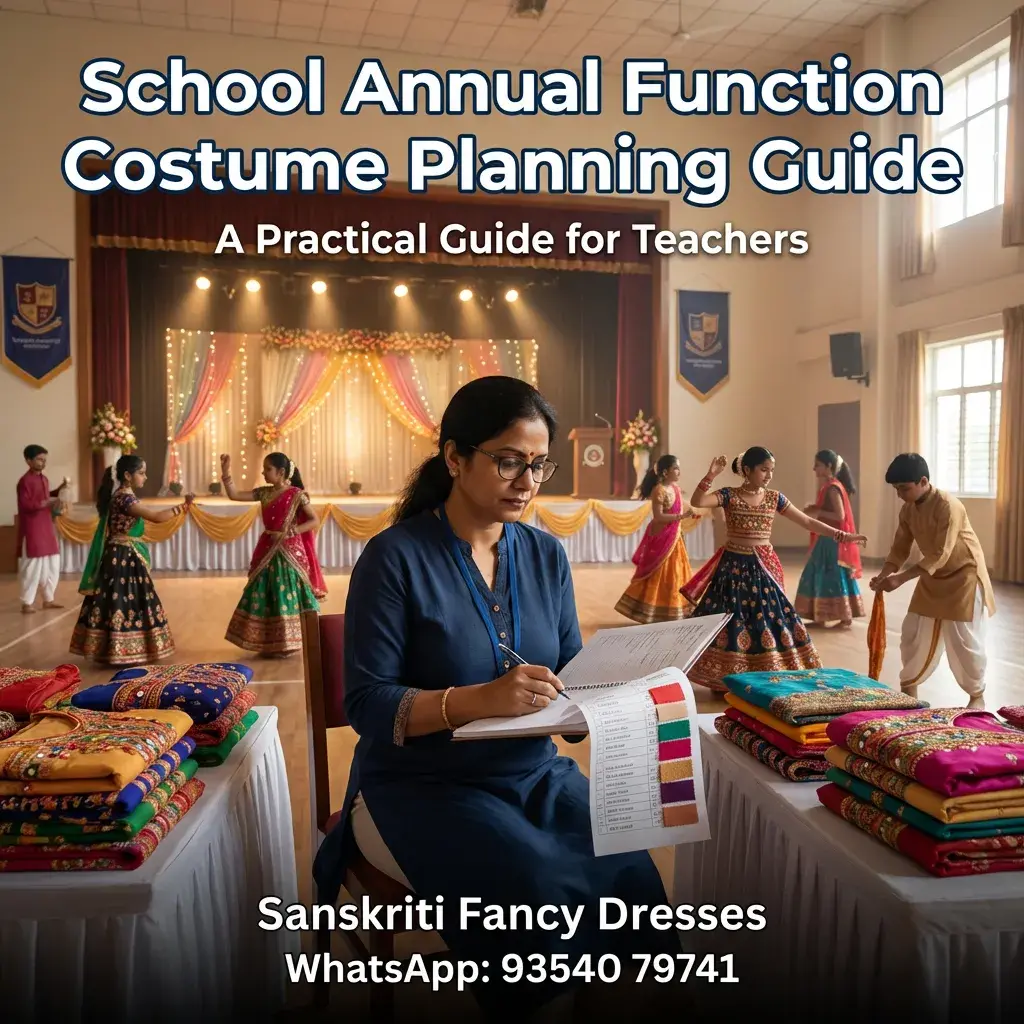
School Annual Function Costume Planning usually begins with excitement but slowly turns into responsibility. Every school wants its annual function to be memorable. Students practice for weeks, teachers coordinate performances, and parents eagerly wait to see their children on stage.
Now imagine a real situation that many schools experience.
A student comes home after rehearsal and tells his mother that he has been selected to perform as a freedom fighter in the annual function. The child is excited and proud. But after a few minutes he asks a simple question.
“When will I get my costume?”
The parent does not have a clear answer. The next day the parent asks the class teacher. The teacher checks with the event coordinator. The coordinator checks with the costume supplier. Slowly, confusion begins to grow.
Now think about this situation in a school where 50 or even 100 students are performing.
Some students may get costumes early. Others may still be waiting. A few costumes may not fit properly. Some accessories may be missing. Teachers start receiving questions from parents, and the pressure slowly increases.
At this stage teachers realize something important. Costume planning is not a small task. It is actually an important part of event management.
If costumes are planned properly and at the right time, the entire annual function preparation becomes smooth. But if this part is delayed or handled without structure, even a well prepared event can face unnecessary stress.
This guide explains how schools can plan costumes step by step so that teachers, students, and parents can experience the annual function with confidence instead of confusion.
Why Costume Planning Becomes Stressful During School Annual Functions
School annual functions involve many responsibilities. Teachers handle rehearsals, manage student participation, coordinate with dance instructors, and communicate with parents. In the middle of all these responsibilities, costume planning often becomes an additional challenge.
From the outside, arranging costumes may look simple. But teachers who manage school events know that it requires careful coordination.
The first challenge is timing. Many schools start discussing costumes only when the event date is very close. At that stage options become limited. Sizes may not match perfectly, accessories may not be available, and teachers may have to compromise on certain details.
The second challenge is consistency. During a stage performance, visual balance matters. If some students appear well dressed while others look incomplete, the overall presentation may lose its impact.
Another concern is student comfort. A costume may look beautiful but may not be comfortable for children to perform in. Teachers must consider both appearance and practicality.
When these factors are managed carefully, costume planning becomes easier. But when they are ignored, teachers often experience unnecessary stress.
That is why experienced schools treat costume planning as an early stage planning activity rather than a last minute arrangement.
When Schools Should Start Planning Annual Function Costumes
Timing plays a major role in successful costume planning. Schools that start planning early usually experience fewer complications.
Ideally, schools should begin discussing costume requirements six to eight weeks before the annual function. At this stage teachers and coordinators can discuss possible themes and performance categories.
Around four to five weeks before the event, student roles should be finalized. Once teachers know which students will perform which roles, they can estimate how many costumes will be required.
Three to four weeks before the event is the right time to confirm costume availability and arrange size groups. This step helps schools coordinate bulk costume arrangements without confusion.
One week before the event, a rehearsal preview can be helpful. Students can check how costumes look on stage and whether any adjustments are required.
When schools follow this structured timeline, teachers feel more confident and parents receive clear information about costume arrangements.
How Schools Should Choose Themes for Annual Function Performances
Theme selection is one of the most creative parts of annual function planning. At the same time, it should also be practical.
Schools often select themes such as Indian cultural heritage, freedom fighters, historical personalities, mythological characters, and classical dance performances. These themes are visually strong and familiar to audiences.
When choosing a theme, teachers should consider the age group of students. Younger students may perform better with simple and recognizable characters, while senior students may handle more complex performances.
Another important factor is availability. Sometimes a theme sounds interesting but becomes difficult to execute if the required costumes are not available in sufficient quantity.
Experienced event coordinators often prefer themes that are simple, visually appealing, and practical to arrange. This approach helps teachers focus on performance quality rather than struggling with costume availability.
Managing Costumes for Many Students in a School Event
Handling costumes for one or two students is easy. Managing costumes for fifty students requires organization.
Teachers can simplify this process by creating a structured student costume list. This list should include basic information such as student name, class, role, costume type, and size group.
This simple list helps teachers track costume assignments clearly. It also makes communication with costume suppliers easier.
Bulk planning also benefits from flexibility. Exact measurements are not always necessary for stage costumes. Size grouping based on age or height can work effectively.
Another helpful strategy is keeping a few extra costumes available. School events often involve last minute changes in participation. Having backup costumes can prevent unnecessary stress on the event day.
Why Accessories Are Important for Stage Performances
Accessories are sometimes overlooked during costume planning. However, they play an important role in stage presentation.
A mythological character may require a crown or jewellery. A historical personality may require a cap or specific prop. Cultural costumes may require additional elements such as belts, dupattas, or decorative items.
Without these accessories, costumes may appear incomplete on stage.
Teachers should confirm whether accessories are included with costumes or need to be arranged separately. This small step can significantly improve the visual quality of stage performances.
Checking accessories during rehearsals can also help teachers ensure that students feel comfortable while performing.
How Schools Can Avoid Last Minute Costume Problems
Most costume related problems arise from rushed planning. When schools take a proactive approach, these problems can be avoided.
The first step is early communication. Teachers should discuss costume plans with parents and event coordinators well before the event.
The second step is clear documentation. Maintaining a simple student costume list helps teachers track assignments and avoid confusion.
The third step is rehearsal checking. A rehearsal preview allows teachers to see how costumes appear under stage lighting and whether adjustments are required.
By following these practices, schools can reduce the chances of last minute surprises during the annual function.
Common Costume Planning Mistakes Schools Should Avoid
During annual function preparation, schools sometimes repeat similar mistakes.
One common mistake is starting costume planning too late. This often results in limited options and unnecessary compromises.
Another mistake is ignoring accessories during the planning stage. Teachers may assume that accessories are included with costumes, but this is not always the case.
Sometimes schools also choose themes that are visually attractive but difficult to arrange in bulk.
A practical approach helps avoid these issues. Clear planning, realistic themes, and early coordination make costume management easier for teachers.
A Simple Costume Planning Checklist for Teachers
Teachers often appreciate a simple checklist that helps them organize tasks efficiently.
Before the annual function, schools can review the following points.
Event theme finalized
Student roles assigned
Costume quantity estimated
Student size groups prepared
Accessories confirmed
Costume availability verified
Rehearsal preview completed
Backup costumes arranged
This checklist helps teachers ensure that all essential steps are completed before the event day.
Final Thoughts
A school annual function is not just a performance event. For students it is a moment of confidence and joy. For parents it is a proud memory. For teachers it represents weeks of planning and dedication.
When costume planning is done early and systematically, the entire event preparation becomes smoother. Teachers can focus more on rehearsals and stage coordination instead of worrying about last minute arrangements.
Many schools prefer working with experienced costume coordinators who understand the practical requirements of school events. In cities such as Greater Noida, Noida, Noida Extension, and Jaipur, schools often coordinate their annual function costumes with Sanskriti Fancy Dresses, a costume rental and sales platform founded by Sapna Kumari.
The brand focuses on supporting schools with bulk costume coordination for cultural programs, fancy dress competitions, and stage performances.
With thoughtful planning and the right support, teachers can transform the annual function into a memorable experience for every student.
Read Also
- How Schools Can Avoid Last Minute Costume Problems
- What Teachers Should Check Before Ordering Costumes
Frequently Asked Questions
When should schools start planning costumes for the annual function
Schools should ideally start costume planning six to eight weeks before the event so that themes, roles, and costume availability can be organized smoothly.
What is the easiest way to manage costumes for many students
Creating a structured student costume list with names, roles, and size groups helps teachers manage bulk costume planning effectively.
How should schools choose themes for annual function performances
Themes should be visually appealing, suitable for students’ age groups, and practical for bulk costume arrangements.
Why are accessories important for school stage performances
Accessories complete the visual appearance of costumes and improve the overall stage presentation.
What are the most common costume planning mistakes schools make
Late planning, ignoring accessories, and selecting impractical themes are some of the most common mistakes.
How can teachers avoid last minute costume problems
Early planning, clear communication with parents, and rehearsal previews can significantly reduce last minute issues.
Should schools keep extra costumes for emergencies
Yes, keeping a few extra costumes helps manage last minute participation changes or unexpected issues.
Why do many schools prefer working with specialized costume providers
Specialized costume providers understand school event requirements and can help coordinate bulk costumes more efficiently.

 Start Chat