
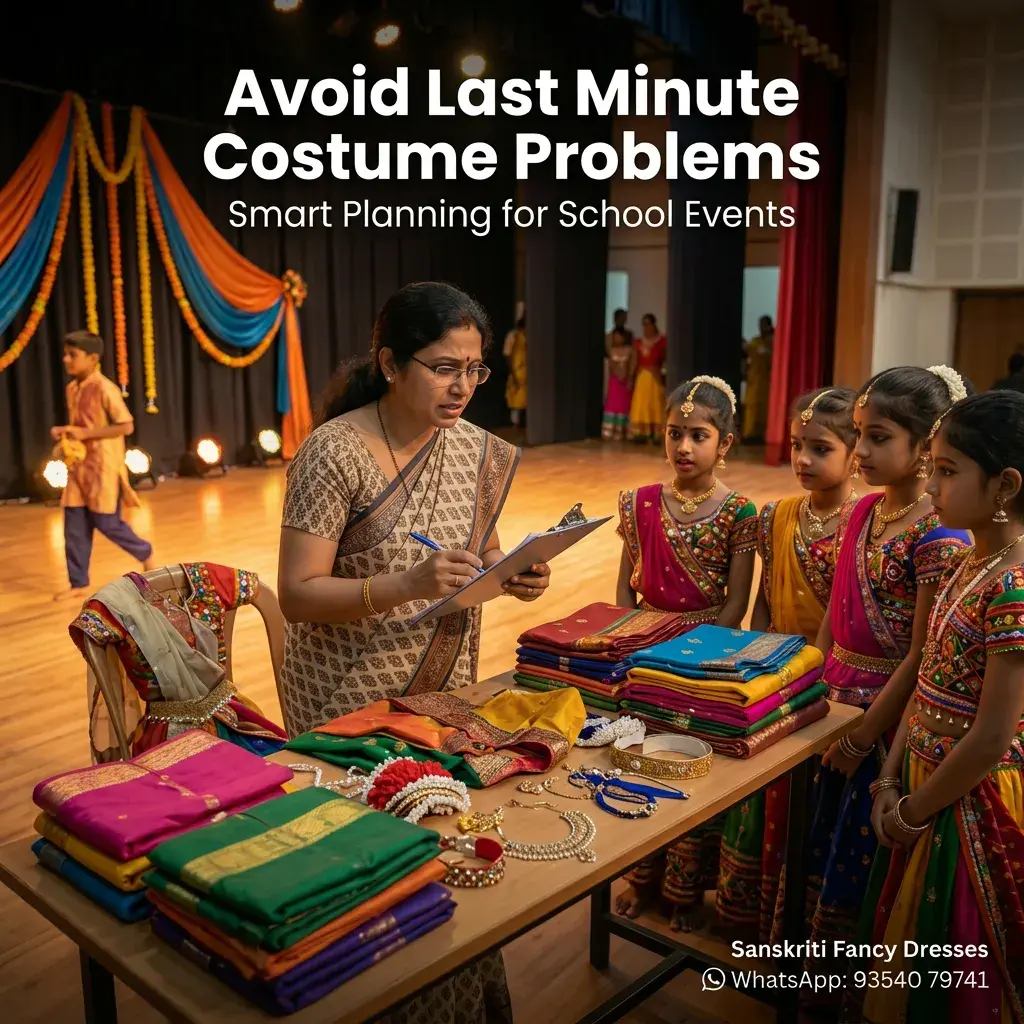
How Schools Can Avoid Last Minute Costume Problems is a question that quietly worries many teachers every year. Annual function season brings energy into the school campus. Students practice dance routines, drama rehearsals begin, teachers finalize performance lists, and parents start waiting for the big day.
But behind all this excitement there is usually one important responsibility that quietly creates pressure for teachers. One responsibility stands out during this time.
Costume planning.
Let us look at a real situation that many schools experience.
A teacher is standing near the stage during afternoon rehearsal. A group of students are practicing a cultural dance performance. Everything seems to be going well. Music is playing, students are trying to remember their steps, and the dance teacher is giving instructions.
Suddenly one student walks toward the teacher and asks a very simple question.
“Ma’am, when will we get our costumes?”
The teacher smiles and replies that arrangements are being made. But inside the teacher’s mind several questions begin to appear.
How many costumes will be needed?
Will the sizes fit every student?
Will accessories be included?
What if the costumes arrive late?
Now imagine that this teacher is managing a performance with sixty students.
Parents are sending messages.
Students are excited and asking questions.
The event date is slowly coming closer.
If costume planning has not been done properly, even a well prepared annual function can suddenly become stressful.
Now think about the teacher’s position. The teacher is responsible for the performance, the students, and the final presentation in front of parents and school management.
This is why experienced schools treat costume planning as an important part of event preparation rather than a last minute task.
When planning begins early and coordination is clear, most costume problems can be avoided easily.
This guide explains practical methods schools can use to prevent last minute costume confusion.
Why Last Minute Costume Problems Usually Happen in Schools
From the outside, arranging costumes may look like a small task. But teachers who organize school events understand that many small details must come together for everything to work smoothly.
During annual function preparation teachers already have many responsibilities. They manage rehearsals, guide students, coordinate with dance instructors, maintain attendance records, and answer questions from parents.
Costume planning becomes another responsibility added to this long list.
One of the biggest reasons costume problems happen is late planning.
In many schools, the conversation about costumes begins only when the event date is very close. At that stage teachers suddenly realize that several decisions still need to be made.
Some costumes may not be available in the required quantity. Some sizes may not match the students. Accessories might not be included.
Another problem is unclear coordination.
Teachers may assume that items such as crowns, belts, jewellery, or props are included with the costumes. Later they discover that these items must be arranged separately.
There is also the challenge of stage presentation.
When students appear on stage, costumes must look balanced and coordinated. If some students appear perfectly dressed while others look incomplete, the overall visual impact becomes weak.
Teachers feel this pressure deeply because the audience does not see the planning process. Parents and school management only see the final performance.
That is why experienced event coordinators recommend starting costume planning early and following a structured approach.
The Right Timeline for School Costume Planning
One of the easiest ways to avoid last minute costume problems is to follow a clear planning timeline.
Annual function preparation usually starts several weeks before the event. Costume planning should follow a similar schedule.
Around six to eight weeks before the event, teachers and coordinators should begin discussing possible performance themes. Cultural dances, historical characters, and group presentations can be explored during this stage.
Around four to five weeks before the event, student roles should be finalized. Once teachers know which students will perform which roles, it becomes easier to estimate how many costumes will be required.
Around three to four weeks before the event, costume booking should begin. Early booking ensures better availability and gives teachers enough time to coordinate sizes and accessories.
About one week before the event, rehearsal previews should be conducted. During rehearsal students can check how costumes look on stage and whether adjustments are needed.
When schools follow this timeline, teachers feel more confident because they have time to manage unexpected issues calmly.
Planning early does not remove every challenge, but it reduces stress significantly.
Theme Planning Tips Schools Should Follow
Theme selection is one of the most exciting parts of annual function preparation. At the same time it should be practical.
Many schools choose themes such as Indian cultural heritage, freedom fighters, mythological characters, or traditional dance performances. These themes are visually strong and easy for students to understand.
Sometimes schools make the mistake of choosing themes that are too complicated.
For example, a theme that requires many unique characters may require completely different costumes for each student. This makes costume coordination difficult.
Experienced teachers often prefer themes that allow some similarity among costumes. Cultural group dances and historical presentations often work well because costumes can be arranged in sets.
Another common mistake is changing the theme very late.
When themes change close to the event date, costume planning must start again from the beginning. This creates unnecessary pressure for teachers.
Once a theme is finalized, it is better to keep the plan stable unless there is a strong reason to change it.
How Teachers Can Plan Costume Sizes for Many Students
Handling costume sizes for many students can become confusing if the process is not organized properly.
Collecting exact measurements from every student is often difficult. Students may forget to bring measurements or parents may send incorrect information.
Many schools solve this challenge by using size grouping.
Students can be grouped according to age or approximate height.
Primary students
Upper primary students
Middle school students
This method makes bulk costume planning easier.
Teachers can also maintain a simple costume planning sheet. The sheet may include student name, role, costume category, and size group.
Such lists help teachers keep track of which student requires which costume.
When information is clearly organized, coordination with costume providers becomes easier and faster.
Why Accessories Should Never Be Ignored
Accessories play an important role in stage presentation.
A costume may look beautiful on its own, but without accessories the character may appear incomplete.
For example, a mythological character may require a crown or jewellery. A historical personality may need a cap or a prop. Cultural costumes may require belts, dupattas, or decorative elements.
Teachers sometimes focus only on the costume itself and forget about these supporting items.
During rehearsals students may realize that their performance looks different without accessories. At that moment teachers may not have enough time to arrange them.
That is why accessories should always be confirmed during the planning stage.
Teachers should ask simple but important questions.
Are crowns included?
Are belts included?
Are props included?
These details may appear small but they can make a big difference during the final performance.
Coordination Tips for Teachers and Event Coordinators
Costume planning becomes easier when coordination is organized.
Usually several people are involved in annual function preparation. Class teachers, event coordinators, dance instructors, and sometimes parents participate in the planning process.
When communication is scattered confusion increases.
Many schools solve this problem by appointing one person as the costume coordination lead. This person communicates with costume providers and keeps track of costume assignments.
Teachers can also create a simple communication system so that parents clearly understand costume arrangements.
Clear instructions reduce unnecessary questions and help teachers focus on preparing students for the performance.
Common Costume Planning Mistakes Schools Make
Many schools repeat the same mistakes every year during costume planning.
The most common mistake is starting too late.
Teachers sometimes believe costumes can be arranged quickly. But bulk costume arrangements usually require time.
Another mistake is ignoring accessories during planning. Teachers may assume accessories are included with costumes, but this is not always the case.
A third mistake is not maintaining a proper costume list. Without documentation teachers may forget which student needs which costume.
Finally, schools sometimes underestimate participation changes. Students may withdraw from performances or new participants may join.
Recognizing these mistakes helps teachers plan more carefully.
A Simple Checklist Teachers Can Use
Teachers often find it helpful to use a simple planning checklist.
Before the annual function teachers can review the following points.
Event theme finalized
Student roles assigned
Costume quantity estimated
Student size groups prepared
Accessories confirmed
Costume booking completed
Rehearsal preview conducted
Backup costumes arranged
This checklist ensures that no important step is missed during preparation.
Final Thoughts
School annual functions are emotional events for everyone involved.
Students feel proud when they perform on stage. Parents feel happy watching their children. Teachers feel satisfied when weeks of preparation come together successfully.
Costume planning plays an important role in making this event successful.
When schools begin planning early and coordinate properly teachers can focus more on rehearsals and guiding students rather than worrying about last minute arrangements.
Many schools prefer working with experienced costume providers who understand the practical needs of school events. Sanskriti Fancy Dresses, founded by Sapna Kumari, supports schools with bulk costume coordination for annual functions, cultural programs, and fancy dress competitions.
If you are also planning a school event and feel uncertain about costume arrangements, it is always better to discuss requirements early.
Sometimes a simple conversation can make the entire planning process easier.
Read Also
Frequently Asked Questions
When should schools start planning costumes for the annual function
Schools should ideally begin costume planning six to eight weeks before the event so that themes, sizes, and costume arrangements can be organized smoothly.
Why do last minute costume problems happen
Most costume problems happen because planning begins late or communication between teachers, parents, and costume providers is unclear.
How can teachers manage costumes for many students
Teachers can create a simple costume planning list with student names, roles, and size groups to organize bulk costume arrangements.
Why is early costume booking helpful
Early booking ensures better costume availability and gives teachers time to handle adjustments if required.
How can schools simplify size planning
Grouping students by age or height range helps teachers manage costume sizes easily for large groups.
What accessories should teachers confirm before booking costumes
Teachers should confirm items such as crowns, belts, jewellery, caps, and performance props.
What are common mistakes schools make during costume planning
Late planning, ignoring accessories, and changing themes close to the event date are common mistakes.
Why do schools work with specialized costume providers
Specialized costume providers understand school event requirements and can coordinate bulk costumes more efficiently.

 Start Chat