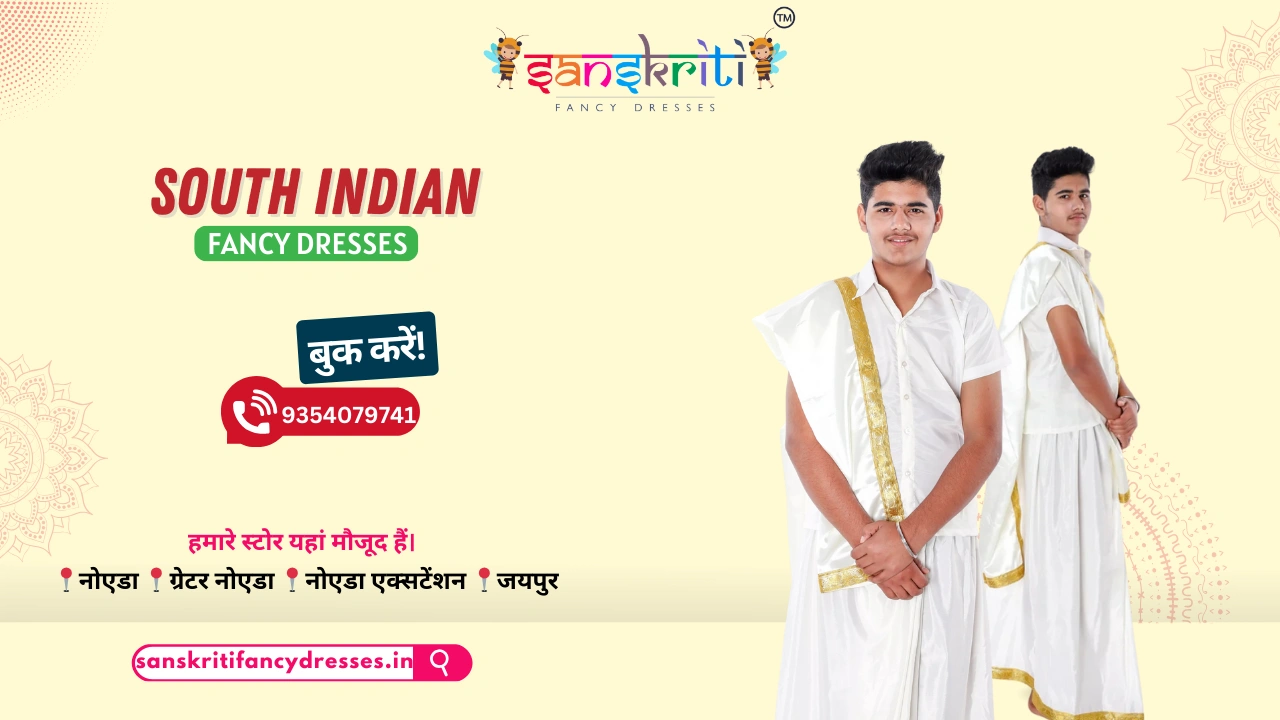
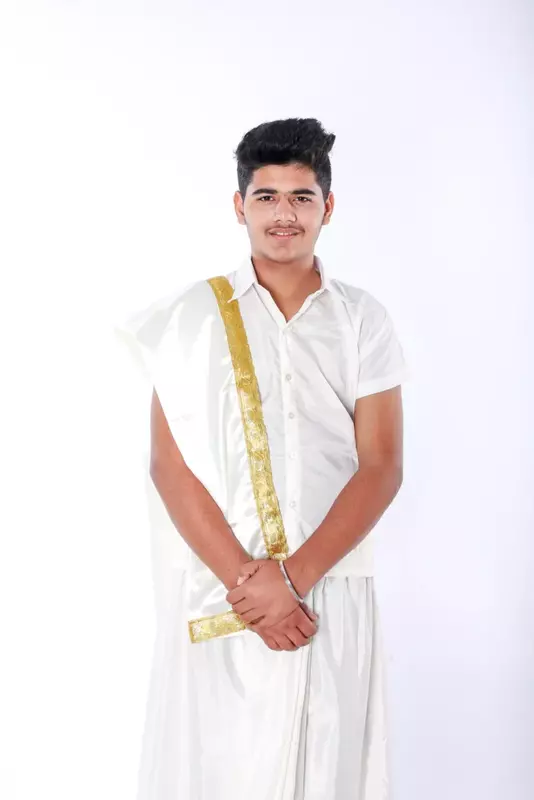
South Indian boy costume consisting of a dhoti and shirt is one of the traditional and classical attire representing the culture and heritage of South India. The dhoti is a long length of cloth that is wrapped around the waist and is worn with a basic shirt or kurta.
A dhoti and shirt costume is comfortable, smart, and is a good fancy dress outfit for school functions, cultural events, and fancy dress competitions. It is a great medium for a boy to dress in traditional attire while taking part in South Indian customs and many festivals.
The dhoti and shirt costume can be worn with pride as a representation of simplicity and culture and is an option for parents to select for their child during events like Independence Day, Republic Day, or regional festivals to help connect them to their roots. With the addition of a few accessories such as a small angavastram (shoulder cloth) or traditional sandals etc., the dhoti and shirt could be a complete Indian boy fancy dress costume.
From a stage perspective, it looks smart and presented in a South Indian traditional way. When a child wears a dhoti and shirt costume, it sheds light on South Indian traditions and culture, customs, traditions and therefore the dhoti and shirt is a great option for boys and as a fancy dress for a cultural occasion/day.
Cultural Importance Of Dhoti And Shirt In South India
The dhoti and shirt’s existence in South India has cultural significance developed out of history and context, across centuries. In the past, the dhoti as an everyday dress code for boys and men, across Tamil Nadu, Andhra Pradesh, Kerala, and Karnataka, was abundant since it was comfortable to wear in warm climates, easy to wear, and most importantly, it signified purity.
Today, many temples in South India would only allow boys and men to enter temples if they are in dhotis, showing respect for that which is divine. The dhoti and shirt is more than a costume then for boys, it represents respect towards culture and religion.
When boys wear these garments for festivals at home and school (Pongal, Onam, Ugadi), there is a sense of belonging. Schools allow the children to wear these traditional costumes for cultural days at school to make sense of their heritage. Boys experience that clothing is more than fashion, an item of clothing that carries identity and values, worthy of pride and celebration.
Traditional Features Of South Indian Dhoti For Boys
The boy’s dhoti costume from South India is an age-old attire that signifies culture, simplicity and grace. The dhoti usually comes in white or cream, featuring a gold zari border that is called ‘pattu,’ which embellishes the simplicity of the fabric.
The dhoti is wrapped and tied around the waist neatly, allowing children to don a serious, respectable outfit that still allows flexibility and comfort. The accompanying shirt is often half-sleeve and consists of cotton or silk fabric as a touch of tradition and neatness.
When it comes to dressing younger boys, dhotis that are elasticated at the waist are easier for parents. The cotton dhotis are used for casual cultural events and traditional occasions; while the silk dhotis are reserved for formal special occasions.
Highlights of Traditional South Indian Boy Dhoti Dress:
- The dhoti is rectangular, almost always white or cream in color, although a gold zari border (‘pattu’) may be an option. The dhoti is usually draped snugly and folded around the waist.
- Half-sleeved shirt in cotton or silk for a traditional appearance.
- Elastic waist dhoti for infants or toddlers for easy dressing.
- Ideal for cultural event and school performances, or to wear for ceremonies.
- Combines Simplicity, traditional style and comfort.
Styling The Shirt With Dhoti For An Authentic Look
Styling a shirt with the dhoti is an art to perfection and is also what finishes the authentic look of the South Indian boy costume. For a traditional style and a simple look, parents can tuck a plain white or cream shirt in with the dhoti. The shirt can have golden borders or embroidery for a festive look, as some parents tend to keep it simple but elegant at the same time. This way, the boy is said to be comfortable and represents South India from a stylistic point of view.
For grand events, such as weddings or a stage at school, a silk shirt in pastel or a light golden col can be worn and even an angavastram (a draped shawllike garment) worn over the shoulder to enhance the look even more. These styling decisions are about cultural practice and teach boys how to wear their clothing with pride. When styled correctly, the dhoti and shirt dress can quickly turn from being referred to as a ‘costume’ to cultural dress of pride.
Accessories To Match With Dhoti And Shirt Costume
Accessories set dress apart. The dhoti and shirt costume for boys can be elevated by adding a whole new level of spend with a nice traditional waist belt as a tying device (or only purely decorative) known in Tamil as ‘vaddanam’ or ‘arappatai’ with an element of royalty.
Simple anklets, sandals or shoes, and a simple, neatly folded and draped angavastram draping off the shoulders really bring out the South Indian flair for authenticity. When parents see their sons dressed in traditional dress and accessories like these, it brings completeness and finesse to their perception.
In addition, jewellery pieces, such as a simple gold chain, small rudraksha maalai, or even artificial temple jewellery for kids, can be added as per the parent’s preference when dressing the boy. Parents also love adding a small ’tilak’ sandalwood paste on the forehead of the child, which provides immediate devotional and graceful disposition.
The accessories are by no means compulsory, and the benefit is only to enhance the experience of dressing up and make children feel special to be a boy in traditional garb. These are the little things that take the dress mode from ordinary (ten times ordinary) to extraordinary – not to mention the prime photo opportunity can shout, “Say cheese” for precious life memories down the track.
Occasions To Wear South Indian Boy Costume
There are plenty of events where the South Indian boy costume is a great fit. For example, no celebration of festivals such as Pongal, Diwali, Onam, and the visit to temple are complete without boys showing up in traditional clothes.
Schools often have cultural days, fancy dress competitions or Independence Day programs for parents to find the most authentic costumes, or the kids being able to showcase India’s amazing heritage. At those moments, the dhoti and shirt becomes something beyond clothing, it conveys the stories of culture and tradition.
Another grand event, boys wearing dhoti and shirts provide that extra touch of class to weddings. fit in with the elders in the family, allowing for wonderful generational pictures. Also for Bharatanatyam dance events or dramas presenting mythological stories, this costume is often the most suitable. No matter the occasion, the costume allows children to connect with their roots while giving parents an immense amount of pride to see their kids honor tradition.
Instructions For Storing And Caring For Dhoti Costume
Taking care of the dhoti costume is just as important as purchasing it. Since many cotton dhotis are washable and easily stored, it’s important to consider the best ways to store and care for silk dhotis and make sure ‘re cleaned appropriately to maintain shine and zari work. Most parents wrap their silk dhoti costume in muslin and place it in a dry space for storage. The shirt should be ironed pressed so the shirt continues to hold its shape, and these are often stored separately.
When you rent a costume, the rental institution is responsible for maintaining the costume, and parents remain responsible for returning the costume in good condition. It’s a small lesson in discipline to be mindful of how boys respect their clothing by keeping it neat (cleaned or washed) and for respectful use which may include folding once removed. A dhoti costume or dhoti and shirt combination (if cared for appropriately) can last several years and become a family heirloom.
Frequently Ask Questions
What is a South Indian boy dhoti and shirt costume?
This is a traditional outfit formed by a long construct do to wear around the waist, and a shirt, which portrays the South India’s culture, heritage, and elegance..
When can boys wear a dhoti and shirt costume?
Boys can wear it for school competence cultural events, fancy-dress videos, and for festivals like Pongal, Onam and Ugadi!. And at family functions and weddings.
Where can I buy a South Indian boy dhoti costume?
Parents can find authentic dhoti and shirt costumes well made at Sanskriti Fancy Dresses, which offers a range of sizes and fabrics for different age groups.
Can the costume be styled with accessories?
The outfit can be enhanced with items such as an angavastram, waist belt (vaddanam), sandals, or small jewellery. Sanskriti Fancy Dresses offers matching accessories that complete the traditional look.
Are dhoti costumes suitable for both casual and grand occasions?
Sanskriti Fancy Dresses provides cotton dhotis for everyday cultural activities and silk dhotis for weddings, ceremonies, or stage performances, catering to multiple occasions.
How should parents take care of the dhoti and shirt costume?
Cotton dhotis can be washed normally, while silk dhotis need careful storage in muslin cloth in a dry area. Shirts should be ironed to keep a neat, crisp appearance.
Is the dhoti costume comfortable for younger boys?
Many of the dhotis are an elastic waist type so it makes it easy to wear, and young kids can use it to move comfortably or to go to an event, or to a competition.
Where are Sanskriti Fancy Dresses stores located?
Sanskriti Fancy Dresses has stores in Greater Noida, Noida, Noida Extension, and Jaipur. All stores offer a large array of traditional cultural and fusion costumes for customers to view.Customers can choose to visit the store nearest them to see what they have there’s bits of sartorial fun to explore and enjoy.

 Start Chat